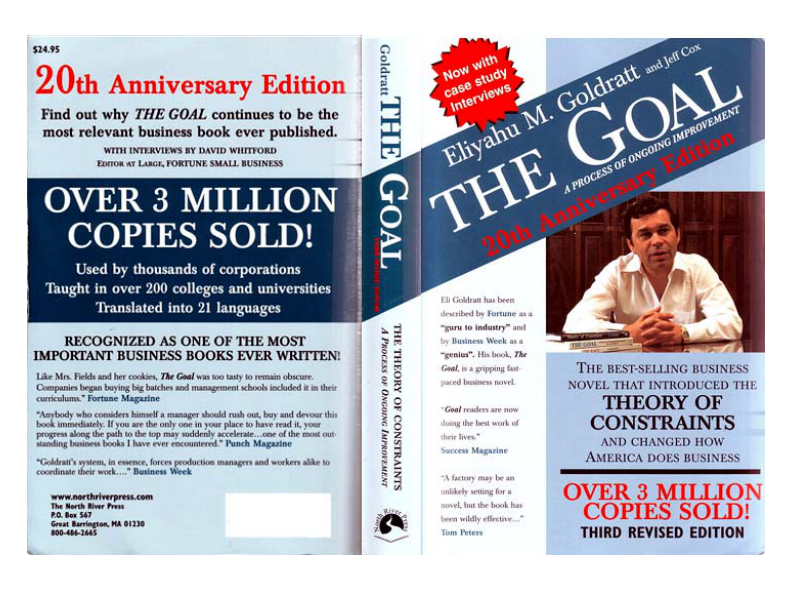
I wanted The Goal to be the first book published on my website because it is the one that affected me the most in recent times. I believe I am a different person because of it, and if someone would ask me to recommend them a non-fiction (business) book, I would give them The Goal.
One skill every good teacher has is the ability to adapt their teaching to the level of students knowledge, by understand how and what the student is thinking. In the book we follow an unexpected student-tutor relationship between John and Jonah. John is a newly appointed plant manager at the struggling manufacturing plant, while Jonah is an recognized expert, who often helps clients like John.
However, Jonah doesn’t simply tell John and his team what to do, he wants them to come to the solution(s) themselves, and in the process gain understanding on why they would do something and what are the undelrlying principles. This way, Jonah always knew in which wah to steer them and they often had the feeling that he is constantly one step in front of them.
One thing I don’t like in popular “self-help” or business books are the unbelivable characters and stories set in real life, which author makes up to constantly prove his or hers point or theory. Goldratt avoids that by making up basically everything in this book. While The Goal is labeled as a business book, it is a complete work of fiction - but it works briliantly, as it is fantastic in explaining a complex concepts in a very simple and digestive way.
One funny thing that he does is, that he draws a story in a way, that you gradually and sequentially get to know all the concepts. He will spend a chapter coming up with a solution to a problem, until one moment, it clicks, and you finally understand where he is going and what is trying to say. Then you flip to the next page and your understanding is shrewded to pieces by the consequences previous solution brought. This also works, because the main character John goes through the same mental process as the reader.
Although, I must say that the second read was much more understandable, maybe because I am not a native speaker. If you read it quickly, than there is a bit of informations overload, as there are constantly things happening. Although, props to author, he does go concept by concept and is not mixing them up all at once. The second read also made things a bit more obvious since I was aquainted with the principles.
Operating on wrong assumptions
One of the first questions Jonah asked John is, what is the goal of the company.
👉 The Goal: The main objective of any manufacturing organization, which Goldratt defines as ‘making money.’
Every action that brings a company closer to its goal is productive. Every action that does not bring a company closer to its goal is not productive”
When we think about the factory or a producing plant, we are thinking about the machines that are CONSTANTLY chuffing and puffing. If one machine is not working, this is bad, as it is underutilised, or we would probably say inefficient. This is the main belief that Goldratt tries to debunk. Our understanding of term efficiency is wrong. We see efficiency as maximization of output of each single part in the chain.
John is recently being promoted to the plant manager of a manufacturing devision that is losing money month after month. All their deliveries are late and they have to constantly work overtime to complete orders.
They have a quality machines that are top of the class they have people so there is no issue with either machines or issue with the personnel , they also cut costs drastically, so the problem is an organisational one. He says “I’ve got the machines I’ve got the people I’ve got all the materials I need. I know there is a market out there because the competitor’s stuff is selling so what the hell is wrong?
The Goal is named that because the core question that John is asking himself is, what is the goal of the company? And it wasn’t as easy question to answer as it might seem at first.
“Can’t you continue to teach me?” “Yes, I can,” he answers. “But first you should find out exactly what it is that you want to learn. Call me then.”
“What are we asking for? For the ability to answer three simple questions: ‘what to change?’, ‘what to change to?’, and ‘how to cause the change?’
Note: Thats the most fundamental abilities for a manager
developed a different set of measurements.” “What kind of measurements are those?” I ask. “They’re measurements which express the goal of making money perfectly well, but which also permit you to develop operational rules for running your plant,” he says. “There are three of them. Their names are throughput, inventory and operational expense.”
💡 Throughput: The rate at which the system generates money through sales; a measure of productive output, not just production.
We have to change the way we think about production capacity. We cannot measure the capacity of a resource in isolation. Its true productive capacity depends upon where it is in the plant.
💡 Bottleneck: A process or resource whose capacity is less than the demand placed on it, limiting the entire system’s output.
There are two principal themes on which you need to concentrate . . . “First, make sure the bottlenecks’ time is not wasted,” he says. “How is the time of a bottleneck wasted? One way is for it to be sitting idle during a lunch break. Another is for it to be processing parts which are already defective—or which will become defective through a careless worker or poor process control. A third way to waste a bottleneck’s time is to make it work on parts you don’t need.”
I sit there marveling that we’re going to reduce the efficiency of some operations and make the entire plant more productive. They’d never believe it on the fifteenth floor.
You mean we not only can do something about excess inventory on the bottleneck parts, but on the non-bottleneck parts as well?" I asked. “Exactly,” said Jonah. But Ralph said, “Sorry, folks, I’m not sure how I’d do that.” Then Jonah explained it to him—and all of us. If Ralph can determine a schedule for releasing red-tag materials based on the bottlenecks, he can also determine a schedule for final assembly. Once he knows when the bottleneck parts will reach final assembly, he can calculate backwards and determine the release of the non-bottleneck materials along each of their routes. In this way, the bottlenecks will be determining the release of all the materials in the plant.
with Jonah somehow it was different. You see, whenever I’m talking with Jonah, I have the distinct feeling that not only is he ready with his questions, he’s also ready with my questions.
‘I’m not asking you to develop the management techniques, only to determine what they should be.’ I’m afraid I’m trying to jump to the next step, to develop them. Determining the management techniques must come from the need itself, from examining how I currently operate and then trying to find out how I should operate."